

IV Therapy Training: What Supplies Nursing Programs Need for Safe Infusion Practice
Infusion therapy is a specific type of intravenous therapy (IV) where blood, medication, nutrients, or other vital fluids are gradually administered to a patient over an extended period of time. Every nursing student must understand how to perform infusions on patients safely and effectively. Otherwise, one small mistake could create serious medical complications for the patient, such as an infection or injury.
Key points:
- Why infusion therapy is an essential clinical skill that nursing students must learn to perform safely and accurately
- How simulation-based training lets students build IV therapy experience on manikins and training arms without any risk to real patients
- The essential IV therapy supplies nursing programs need, including IV catheters, fluid bags, transparent film dressings, alcohol pads, and artificial blood
- Why stocking a range of catheter gauges teaches students to match needle size to a patient's age, health condition, and treatment
- How realistic IV fluid bag labeling helps students practice medication verification and patient safety checks
- Why transparent film dressings protect the insertion site, prevent contamination, and allow continuous visual monitoring
- How proper skin preparation with alcohol pads and antiseptic swabs reduces the risk of infection at the insertion site
- Why practicing with artificial blood helps students grow comfortable with the sight of blood before entering a real clinical setting
Why Your School Should Offer Simulation IV Therapy Training
Simulation nursing programs offer the best IV therapy training to nursing students because they can receive hands-on experience without any risk to real human patients. Most standard simulated IV therapy programs use high-fidelity manikins rather than humans. Manikins are made to resemble real human patients, with some even containing lifelike organs and blood to enhance the simulation experience.
IV training arms are also a great substitute for human patients, and a more affordable one. They are basically manikin arms designed to simulate the arms and veins of a human. Some of them can store and disperse artificial blood as well. So, whether your students use full-size manikins or IV training arms, they can develop the necessary skills and experience of performing infusion procedures in a clinical-like environment.
The Best IV Therapy Supplies for Nursing Programs
Of course, manikins or IV training arms alone are not enough to establish a viable IV therapy training course for your nursing programs. You also need to provide the most realistic IV therapy supplies possible for your students to use. That way, it will be easier for them to apply the skills from their training into a real clinical setting.
Now the big question is, what are the best IV therapy supplies for nursing programs that teach safe infusion therapy practices? Below are the top 5 supplies to consider for your program:
1) IV Catheters
IV catheters are the number one medical supply to stock in your simulation laboratory for your infusion-based nursing program. Make sure you offer an assortment of IV catheters with varying sizes because nursing students must learn how to choose between different catheter gauges based on their patient’s age, health condition, and needed treatment.
For instance, working with multiple catheter sizes can help students learn why large catheter gauges are better for adult trauma patients, and why smaller catheter gauges are ideal for seniors and children. It will take a lot of repeated practice inserting and removing the IV catheters, but eventually the students will learn the routine and perform it flawlessly.
2) IV Fluid Bags
IV fluid bags are another critical medical supply to have in your simulation laboratory. They support IV catheters by storing the liquid medication, nutrients, electrolytes, or other fluid treatment before being administered into the patient.
For simulation purposes, the IV supply bag will likely contain a sterilized saline solution to simulate a real fluid-based treatment administered through an IV catheter. Since the IV bags are meant for educational purposes only, they don’t come with any real treatment solutions in them.
The bags should have realistic labeling to help your nursing students become more familiar with reading labels to verify the medication and patient safety procedures. The more they continue to practice reading labels, the better they will get at it.
3) IV Transparent Film Dressing
An IV transparent film dressing is a securement tool for protecting and stabilizing the IV insertion site to enable continuous visual monitoring within the patient. The catheter will not move around as much with the dressing in place. It is also a sterilized, waterproof barrier to prevent contaminants, such as liquids and bacteria, from entering the body through the insertion site.
The dressing offers up to 7 consecutive days of wear time. It is highly breathable and comfortable enough for the patient to wear without needing temporary removal. The best dressings are even latex-free and hypoallergenic.
4) Alcohol Pads and Antiseptic Swabs
Proper skin preparation is a critical step in IV therapy. Before the catheter insertion, nursing students must practice cleansing the insertion site with alcohol pads or antiseptic swabs to disinfect it thoroughly. It is another important step in reducing the risk of infection by eliminating all bacteria and viruses currently present on the patient’s skin.
Please make sure you teach your nursing students the proper technique in applying the alcohol pad wipes or antiseptic swabs to the insertion site. The general technique includes washing hands, putting on medical gloves, and rubbing the pad or swab outward from the center of the insertion site in a circular motion.
5) Artificial Blood
Nursing students must get used to seeing blood on a daily basis. After all, a big part of the nursing profession involves being around blood continuously, especially when conducting IV therapy. That is why it is imperative to stock your simulation laboratory with artificial blood.
Artificial blood is a realistic simulation fluid that resembles the sight and texture of real human blood. You can add it to the IV trainer arms, full-body manikins, or IV bags of your simulation lab so that it has a profound visual impact on your nursing students. As they practice their IV therapy procedures regularly, your students will grow accustomed to the sight of blood. Then, when they work with human patients in a real-life clinical setting, the sight of blood won’t bother the students as much.
Obtain Your IV Therapy Supplies Today
Do you want to ensure that your nursing students have the best medical supplies to practice IV therapy administration procedures? If so, you will need a reputable medical supplier that you can trust.
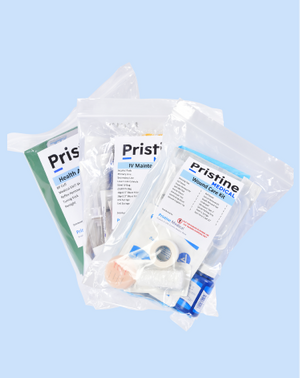
Pristine Medical is the premier medical supplier for nursing schools worldwide. It has a wide variety of high-quality supplies designed specifically for IV therapy training, including manikins, IV trainers, artificial blood, and dressings.
All the supplies are realistic simulations of the same supplies used in real clinical settings. Your nursing students can easily transfer the experience of working with these supplies into their true nursing profession after graduation.
Frequently Asked Questions About IV Therapy Training in Simulation
1. What is infusion therapy in nursing?
Infusion therapy is a type of intravenous treatment where fluids such as medication, blood, nutrients, or electrolytes are administered to a patient slowly over an extended period. Nurses use it to deliver treatments that need controlled, continuous dosing directly into the bloodstream.
2. Why should nursing programs use simulation for IV therapy training?
3. What supplies does a nursing program need for IV therapy training?
4. What is the difference between a full-body manikin and an IV training arm?
5. Why do students need to practice with different IV catheter sizes?
6. Why is skin preparation important before catheter insertion?
7. How long can a transparent film dressing stay in place?
8. Why is artificial blood used in IV therapy training?