

The Rights of Medication Administration: How to Teach Them in Simulation
The rights of medication administration are most useful when students learn them as an active safety process rather than a list to memorize. In simulation, each right can be connected to a specific behavior, such as verifying patient information, matching the medication order with the label, calculating and checking the dose, confirming the route and timing, documenting accurately, and stopping when information appears incomplete or inconsistent. This approach helps students develop a repeatable medication administration routine while also strengthening clinical judgment.
Key Points
- The medication administration rights should be taught as a structured safety framework rather than a memorization exercise.
- Students should practice connecting every right to a specific verification step before administering a medication.
- Simulation can combine patient information, medication orders, realistic labels, dosage calculations, routes, and documentation.
- Programs may teach different numbers or versions of medication administration rights, so training should align with institutional policy.
- Scenarios should include intentional discrepancies so students practice recognizing when medication administration should be paused.
- Students need opportunities to practice medication safety while dealing with realistic interruptions and distractions.
- Simulated medications allow learners to repeat medication preparation and administration tasks without exposing real patients to medication errors.
- Debriefing should focus on both the student's actions and the reasoning behind each verification decision.
- Competency assessment should evaluate recognition of unsafe situations in addition to completion of the administration procedure.
All nurses, doctors, and healthcare professionals are trained to administer medications to patients under different clinical scenarios and situations. Although medication administration is usually a nurse or medical practitioner’s responsibility, there can be times when doctors administer medication as well. Because of this, all nursing and medical students need to understand the rights of medication administration.
What are the Rights of Medication Administration?
The rights of medication administration are the six core safety practices of administering medication to patients. Before students practice the rights of medication administration in a simulation environment, you must first teach them what they are. The six rights include the following:
- Right Patient - Verifying the identity of the patient by looking for their name and date of birth. This information is usually on the patient’s wristband.
- Right Medication - Compare the doctor’s medication order to the medication label to ensure it is the right medication to administer to the patient.
- Right Dose - Calculate and measure the correct medication dosage amount for the patient.
- Right Route - Administer the medication the proper way, such as orally or intravenously.
- Right Time - Administer the medication at the appropriate time or intervals, such as every hour or day.
- Right Documentation - Record all the medication administration actions taken to keep a log of them for future reference.
Some medical schools may have more or fewer rights in their medication administration guidelines. However, the six rights of medication administration listed above are the general rights included in most lists. If your students can learn to perform them well, they can ensure their patients receive the right medications safely and accurately.
The Best Practices for Teaching the Rights in a Simulation Setting
Once your students understand the meaning behind the rights of medication administration, the next step is to let them practice those rights in a realistic simulation setting. Here are the best practices for setting up a simulation environment where you can properly teach these rights and let your students practice enforcing them:
1) Begin with Low-Fidelity Simulation Tools
Beginner students should first practice administering medications using low-fidelity simulation tools, such as injection pads, pill splitters, and medication carts. These simple tools allow students to focus their attention on the administration process itself rather than the patient. It is the best way to help students practice and remember the rights by building muscle memory and confidence before working with a manikin or simulated patient. Then, by the time they begin working with a manikin or patient, they won’t feel so overwhelmed by the process.
2) Introduce High-Fidelity Manikins
Try introducing high-fidelity manikins or task trainers to students after they have gained enough confidence working with the low-fidelity tools. Manikins are lifelike, full-size or half-size patients with a head, body, and limbs. Some of the higher-end manikins even have artificial organs, blood, and response mechanisms to create the most realistic simulated training scenario possible.
For instance, if you want your students to practice IV medication administration, you could supply them with a high-fidelity manikin or task trainer arm to serve as the patient. Add simulated blood to the manikin or arm (if allowed) to create more realism in the simulation. After all, your students need to experience seeing blood in clinical settings to learn to avoid making an emotional reaction to it.
3) Use Simulated Medications
Stock your laboratory with a wide variety of simulated medications, such as vials, ampules, and oral medications. All of them are useful for teaching the rights of medication administration under various clinical scenarios. Since the rights of medication administration apply to all forms of medication, your students need the experience of working with each type of medication while enforcing the rights.
For instance, your students should repeatedly practice identifying medication, measuring dosages, reading medication labels, and administering medication for each type of medication. Simulated medications contain a saline solution with no real medication in them. Even so, it is best to only administer simulated medications to manikins and task trainers rather than real patients.
4) Create Simulated Scenarios with Safety Errors
Simulated environments create the freedom for medical mistakes to be made without consequences. That is why they make such effective learning environments, because students learn best when mistakes are made.
For this reason, you should create simulated clinical scenarios where safety mistakes are made that violate the rights of medication administration. Some examples of these mistakes or errors might include the following:
- The wrong medication given to the patient
- The wrong dosage administered to the patient
- The wrong route used to administer the medication
- Medication bottles mislabeled
- Incomplete medication orders given
- Two patients have similar names
Real clinical environments will occasionally have errors or mistakes like these made. For training purposes, have your students identify the problem in these simulated scenarios created for them. Once your students are capable of identifying these mistakes, they can learn how to correct the mistakes before administering any medication.
For additional hands-on preparation, instructors can also create a dedicated simulated medication administration station where students repeatedly practice verification, preparation, and administration workflows.
5) Hold a Debriefing Session After Each Simulation Exercise
A debriefing is a detailed review of the actions taken during a simulation exercise. You should hold a debriefing session after each simulation exercise to help you and the student better understand what they did right and wrong.
Ask each student the following types of questions:
- How did you verify the patient’s identity?
- How did you confirm the medication dosage?
- What information did you document?
- What route did you use for administering the medication?
- What type of medication did you administer?
The answers to questions like these can help you verify whether the student understood and enforced the rights of the medication administration process.
Acquire the Appropriate Medical Tools for Teaching the Rights
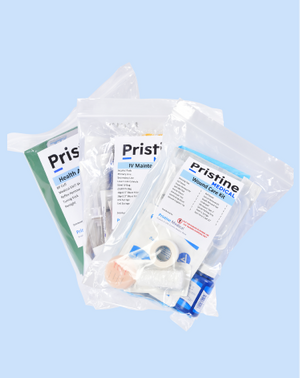
Your students need the best simulation medical tools possible to learn and understand the rights of medication administration. Pristine Medical is the premier supplier of simulated medical tools and equipment for teaching medication administration, such as simulated medications, injection pads, syringes, manikins, and more.
Frequently Asked Questions About Medication Administration Rights
1. How many rights of medication administration should nursing students learn?
The number varies among nursing programs, healthcare organizations, and educational resources. Some frameworks use five or six core rights, while others add elements such as indication, response, education, or additional documentation requirements. Educators should teach the framework required by their program while emphasizing the safety behavior behind each right.
2. Are the medication administration rights enough to prevent medication errors?
3. How can instructors simulate a wrong-patient medication error?
4. What types of medication errors should be deliberately included in simulation?
5. How can documentation be incorporated into medication administration simulation?
6. How should students handle interruptions during medication preparation?
7. When should a student stop the medication administration process and ask for clarification?
8. What makes a medication administration debriefing effective?
9. How should competency in the medication administration rights be assessed?