

How to Set Up an OSCE: Supplies and Station Checklist for Clinical Skills Exams
Setting up an OSCE starts with five groups of supplies at every station: an examination table or hospital bed, basic health assessment kits, personal protective equipment, task-specific supplies for the skill being tested, and a manikin or task trainer standing in for the patient. Stations only produce comparable scores when every student meets the same equipment, the same layout, and the same time limit, which makes the checklist below as much a standardization tool as a shopping list.
Key points:
- Why an OSCE measures practical skill and clinical reasoning under timed conditions in a way written exams cannot
- How students rotate through timed stations while examiners score every candidate against identical criteria
- The five supply groups every station needs, from examination tables and health assessment kits to PPE, task-specific tools, and manikins
- Why realistic surroundings such as a privacy curtain, chair, and bedside table reinforce professional behavior during the exam
- How stocking multiple health assessment kits prevents bottlenecks as students rotate through the circuit
- Why personal protective equipment at every station builds self-protection habits before students reach real patients
- The task-specific supply lists for wound care, medication administration, and phlebotomy stations
- Why high-fidelity manikins and task trainers let programs assess invasive skills before a student touches a live patient
Most medical schools will issue practical tests to their students called Objective Structured Clinical Examinations (OSCEs). These tests are designed to assess a student’s medical knowledge and skills in communication and problem-solving while treating patients in real-life clinical settings. Unlike traditional written examinations, an OSCE measures practical skills and reasoning under timed conditions. It is one of the best ways to determine if your students are ready to treat patients in real life.
How it Works
Each student moves through various timed stations to perform specific medical tasks on manikins or simulated human patients. The instructor’s job is to observe the students at the stations and see for themselves if they can complete the assigned tasks.
Depending on the medical program, the stations could assess all kinds of healthcare techniques and tasks. Some of the most common ones include:
- Patient assessment
- Physical examination and diagnosis
- Phlebotomy
- Catheterization
- Wound care
- Medication administration
- Emergency response
- Infection control
- IV Insertion
- Patient education and communication
Each station should have the same standardized grading criteria to ensure that every student has the opportunity to complete the same tasks under the same conditions and time constraints. To ensure this happens, you must have the necessary supplies available to set up each station.
Setting Up an OSCE
The effectiveness of your OSCE depends on how well you prepare and equip each station with the proper supplies. A poorly equipped station can create confusion and cause your students to make unnecessary mistakes. On the other hand, a well-equipped station will ensure that your students have access to all the required supplies needed for them to demonstrate their knowledge and skills properly.
Below is a station checklist featuring the essential supplies needed for clinical skills examinations:
1) Examination Table or Hospital Bed
The first item that you should have at each station is a standard examination table or hospital bed for the manikin or simulated patient. In any real-world clinical setting, a patient is either lying down or sitting up on a bed or table. It forms the basis for any medical professional to assess and treat their patient in the most comfortable way possible for them.
Feel free to add other standardized items next to the table or bed that might be necessary, such as a chair, bedside table, privacy curtain, and extra linens for the bed. Creating a realistic clinical setting with these items will help students perform naturally while reinforcing their professional behavior.
2) Basic Health Assessment Supplies
The next group of items that you will need is basic health assessment supplies. Pretty much every OSCE contains a station where students assess a patient’s health, such as their vital signs. Because of this, you should consider adding a standardized health assessment kit to one or more stations of your OSCE.
Some of the items that you might find in a health assessment kit include the following:
- Stethoscope
- Penlight
- Thermometer
- Blood pressure cuff
- Measuring tape
- Reflex hammer
- Pulse oximeter
Since multiple students will rotate through each station, it is best to have multiple health assessment kits available to prevent delays between examinations. Also, if your particular health assessment kits don’t have all the basic health assessment supplies needed for your OSCEs, make sure you purchase them separately and add them to your stations.
3) Personal Protective Equipment
Safety is a critical component of operating OSCEs in training laboratories and real-life clinical settings. Adding personal protective equipment to your OSCE stations will help get your students in the habit of protecting themselves and their patients while performing professional clinical procedures.
The most appropriate personal protective equipment to add to each station includes the following:
- Safety goggles
- Disposable medical gloves
- Surgical masks
- Face shields
- Gowns
- Respirators
The focus is on protecting the eyes, mouth, face, and body from contact with bodily fluids, blood, and harmful germs. Not every clinical procedure might require full protection from all these elements, but most of them will. So, it is best to fully stock your stations with all these essential personal protective equipment items.
4) Supplies for Station Specific Tasks
OSCE stations shouldn’t have all the same supplies since each one assesses different types of medical tasks. Now you will need to focus on obtaining the supplies needed to support the specific tasks of each station. Let’s look at some examples to give you a better idea of what to get.
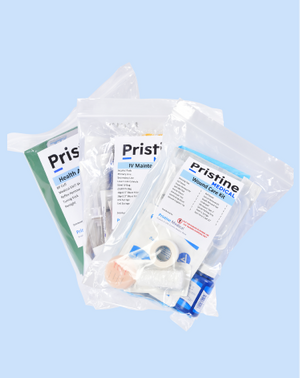
Let’s say you want to assemble a wound care station for your OSCEs. A wound care station would typically have the following supplies from a standardized wound care kit:
- Medical dressing tray
- Under pads
- Exam gloves
- Surgical tape
- Gauze sponges
- Abdominal pads
- Bandages
- Wound closure strips
- Syringes
- Normal saline
- Suture removal kit
- Silicone practice pad
Other examples might include:
Medication Administration Station
- Syringes
- Needles
- Alcohol prep pads
- Simulated medications
- Medication administration records
Phlebotomy Station
- Tourniquet
- Collection tubes
- Bandages
- Sharps container
- Needle holder
- Butterfly needle
- Gauze
5) Manikins and Task Trainers
Now all you need are simulated patients for your students to work with. However, most OSCE stations won’t use human patients until students have already proven their knowledge and skills. So, it is best to stock your stations with high-fidelity manikins or task trainers to serve as the patients.
Task trainers usually focus on simulating one particular body part of a patient, such as an arm, for conducting IV insertions or other specific tasks. High-fidelity manikins are full-size, lifelike replicas of human patients. They make it easier for students to demonstrate a variety of medical skills across various healthcare fields.
Get Your Essential OSCE Supplies
Are you searching for high-quality supplies for setting up your OSCE stations? Pristine Medical is the premier provider of OSCE supplies for medical schools and nursing programs nationwide. You can find all the essential medical supplies needed to add to your testing stations to properly assess the real-world clinical skills of your students.
Frequently Asked Questions About Setting Up an OSCE
1. How long should each OSCE station be?
Most stations run between 5 and 10 minutes, with a short reading period at the door before the candidate enters. Let the task set the length rather than the timetable: a focused history or a hand hygiene demonstration fits comfortably into 5 minutes, while a full physical examination or a procedure that includes setup and disposal usually needs 8 to 10. Whatever you choose, every station in the circuit must run on the same clock so candidates rotate cleanly.
2. How many stations does an OSCE need to give a reliable score?
3. How many sets of supplies do you need for a full cohort?
4. Who should be at a station: an examiner, a simulated patient, or both?
5. How do you keep a station standardized when candidates rotate through all day?
6. Should stations be scored with a checklist or a global rating scale?
7. Do OSCE stations need real needles and sharps?
8. What is a rest station and does the circuit need one?
9. How do you pilot a station before using it in a live exam?