

Phlebotomy Training: Essential Supplies for Teaching Safe Blood Draws
A phlebotomy training lab needs seven core supplies to teach safe blood draws: simulation phlebotomy pads, a standardized IV insertion kit, task trainer arms, high-fidelity manikins, artificial blood, needles in the 20 to 23 gauge range, and a sharps container. Together they let students build venipuncture technique, handle specimens, and practice safe needle disposal on realistic surfaces instead of live patients. The sections below explain what each supply teaches and how to choose it for your program.
Key points:
- Why safe venipuncture technique is a foundational clinical skill for nurses, paramedics, doctors, and medical technologists
- How simulation supplies let students practice needle insertion and see the consequences of errors without any risk to a real patient
- The seven essential phlebotomy training supplies, including simulation pads, task trainer arms, high-fidelity manikins, needles, and sharps containers
- Why silicone simulation pads with realistic skin and vein layers are the most cost-effective starting point for building technique
- How task trainer arms with blood flashback teach students to confirm vein entry before drawing
- Why an assortment of 20 to 23 gauge needles matters for teaching gauge selection
- How artificial blood desensitizes students to the sight of blood before they reach a live clinical setting
- Why every training lab needs a sharps container so correct disposal becomes automatic habit
A phlebotomy is a common procedure where a medical professional inserts a needle into a patient’s vein and draws blood from it. The purpose could be to collect blood for laboratory testing or to donate to someone else who needs the blood.
All kinds of medical professionals perform phlebotomies throughout their careers, including nurses, paramedics, doctors, and medical technologists. Students entering the healthcare field must know how to safely and properly collect blood from patients. It will help prevent them from injuring patients and ensure their blood is useful for testing or donating.
Of course, knowing the proper procedure to perform a phlebotomy is only part of the training process. The other part is having access to the necessary supplies and learning how to use them.
The Best Supplies for Phlebotomy Training
Equipping your phlebotomy training laboratory with realistic medical supplies will give your students more practical experience at drawing blood from patients in a real-life clinical setting. These supplies help enable a simulated phlebotomy training experience where students can feel like they are actually withdrawing blood from a realistic patient. And if they make any mistakes, they can see the consequences of those mistakes and learn from them.
Below are the top seven most essential supplies for teaching students how to withdraw blood safely.
1) Simulation Phlebotomy Pad
A simulation phlebotomy pad is a high-quality silicone pad designed to resemble the texture and characteristics of human skin and veins. Students can practice inserting needles into the pad to simulate the process of extracting blood from patients. Since the pad contains realistic vein and skin simulation, it can accurately help students develop their technique for performing phlebotomies correctly.
Durability is another great aspect of the phlebotomy pad. Since it has a reusable design made of hypoallergenic material, your students can repeatedly practice their technique with the same pads. You can even apply the pad onto a manikin using a strong silicone adhesive if you want to enhance the realism of your students’ learning experience.
2) Standardized IV Insertion Kit
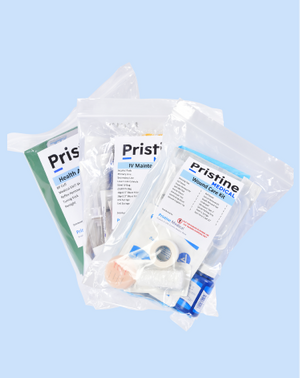
A standardized IV insertion kit is a comprehensive collection of the most critical tools needed to access the vein of a patient for insertion or extraction purposes. It is an all-in-one solution for your students to learn about IV insertions and extractions safely. The common supplies found in an IV-insertion kit include:
-
Tourniquet
-
Alcohol swab
-
Under pads
-
Sterile gloves
-
Catheter
-
Saline-filled syringe
-
Surgical tape
-
Securement dressing
Most of the abovementioned supplies play an important role in performing a safe and effective phlebotomy. The kit might not contain all the essential supplies, but it will provide you with most of the supplies necessary for phlebotomies.
Are you interested in obtaining the insertion kit and simulation pad together? If so, some medical supplies offer package deals where you can obtain a standardized IV insertion kit with a phlebotomy pad.
3) Task Trainer Arms
Task trainer arms are realistic replicas of human arms. They are simulation arms with human-like skin texture, venipuncture sites, vein elasticity, and blood flashback action upon needle insertion. Students can practice their phlebotomy training on the task trainer arms as if they were their patients’ arms. But since no real human patients are involved, there is no risk of injuring a real person.
The most durable task trainer arms can withstand hundreds of practice insertions. Some trainer arms even have replaceable skin and veins so that you can keep your replacement costs as low as possible.
4) Manikins
How would you like to give your students the experience of seeing a realistic-looking manikin as they practice their phlebotomy techniques? Adding a high-fidelity manikin to your phlebotomy training laboratory can help you achieve this objective. The manikin appears like a full-bodied human, with head, body, limbs, and skin. Not only that, but it also contains artificial veins and the ability to bleed upon needle insertion.
High-fidelity manikins may be a bigger investment for your laboratory, but they will give your students the best learning experience possible. They will remember the manikins as if they were real people, which will make it easier for them to apply the same techniques in real patients later in their phlebotomy training program.
5) Artificial Blood
Artificial blood can enhance the realism of the phlebotomy training experience if your students are learning with simulation task trainers or manikins. If they are high-fidelity trainers or manikins, they should have a reservoir where you can add artificial blood. Then, when your students perform insertions or extractions on the trainers or manikins, they can see the lifelike blood come out of them.
Your students need to get into the habit of seeing blood over the course of their phlebotomy training. That way, it will become less disturbing to them and more commonly viewed as part of their job.
6) Needles
A vast needle supply must exist in any simulation phlebotomy training laboratory. After all, needles are what enter patients’ veins to extract blood from them.
Just make sure you choose the proper gauges for the needle sizes. Phlebotomies typically require thinner needles that have a gauge of between 20 and 23. You could purchase an assortment of needles with these gauges or a big box of needles with the same gauge.
7) Sharps Container
A sharps container should exist in every training laboratory and clinical setting. It is how all medical professionals dispose of sharp medical objects after using them, such as needles and syringes. The purpose is to prevent people from accidentally getting hurt or infected by a used sharp medical object.
Your students need to develop the habit of discarding their needles and syringes in a sharps container after performing phlebotomies on their patients. So, please add a sharps container to your laboratory.
Get Your Essential Medical Supplies for Phlebotomy Training
Do you want the most realistic simulation medical supplies for your phlebotomy training program? Pristine Medical offers all the essential medical supplies needed to create a practical, hands-on phlebotomy training experience in a clinical environment.
Frequently Asked Questions About Phlebotomy Training
1. What order of draw should students learn when filling multiple tubes?
Students should follow the standard order of draw to prevent additive carryover between tubes: blood culture bottles first, then coagulation tubes, then serum tubes, then heparin tubes, then EDTA tubes, and finally glycolytic inhibitor tubes. Practicing this sequence on a trainer arm with a multi-tube setup builds the habit before it affects real specimen quality.
2. How many practice draws does a student need before working with real patients?
3. Should a program buy simulation pads or task trainer arms first?
4. How many students can share one task trainer arm?
5. What causes trainer veins to leak or stop giving flashback?
6. How should artificial blood be handled between training sessions?
7. How do you teach needlestick prevention during simulation training?
8. Do students need to practice with butterfly needles as well as straight needles?
9. Can a simulation pad be adapted for patients with difficult veins?