

Infection Control Training: Teaching PPE Donning and Doffing the Right Way
Effective PPE training comes down to two sequences and the hand hygiene that frames them. Donning runs hand hygiene, gown, mask or respirator, eye protection, then gloves. Doffing removes the most contaminated items first, starting with gloves, and repeats hand hygiene along the way. Doffing is where self-contamination usually happens, so it deserves the larger share of practice time. Below are the risk categories students need to recognize and the step-by-step sequences to drill.
Key points:
- Why PPE only protects when donning and doffing are performed correctly every single time
- How simulation lets students repeat both sequences until the order becomes habit rather than recall
- The four categories of risk students must recognize: standard, contact, droplet, and airborne precautions
- Why hand hygiene frames the entire process, before donning begins and again after doffing ends
- How each item should fit, from a gown tied at the neck and waist to a respirator molded to the nose bridge
- When to use sterile gloves rather than non-sterile gloves in patient care
- Why the removal sequence causes the most errors and needs the most supervised repetition
- Which simulation PPE supplies a program needs to run realistic infection control drills
Clinical environments have patients with all types of dangerous illnesses, such as influenza, COVID-19, tuberculosis, and other serious infectious diseases. Healthcare professionals must know how to properly use personal protective equipment (PPE) to protect themselves, their colleagues, and their patients from contracting deadly viruses and diseases.
However, it is not good enough to simply provide PPE to your medical and nursing students. Using PPE might seem self-explanatory, but it can become dangerous if it is used incorrectly or not at all. That is why you should put your students through intense infection control training so that they can develop the habit of putting on PPE each time they treat a patient. It is the best way to minimize the risk of contamination in a clinical setting.
Why Teach PPE Donning and Doffing
Simulation-based infection control training has become essential for teaching infection control to students. It provides realistic scenarios where students can practice the proper techniques of donning and doffing PPE before and after treating patients. Donning refers to putting on the equipment, and doffing refers to taking off the equipment. If either one is done incorrectly, it could greatly increase the risk of spreading disease in a clinical environment.
Simulations offer students the opportunity to repeatedly practice PPE donning and doffing until they can do it perfectly. That will provide students with the knowledge and skills to do the following:
- Protect vulnerable patients (especially those with compromised immune systems)
- Prevent cross-contamination
- Reduce personal exposure to diseases
- Comply with infection prevention guidelines
- Build the confidence to treat patients
- Understand safety and precautions to prevent transmissions
By making PPE donning and doffing training a routine part of your infection control training program, you can help your students become better at preventing the transmission of infectious diseases and improve patient safety in clinical settings.
How to Teach
Teaching PPE donning and doffing requires students to understand the different kinds of safety risks that exist in a clinical setting. Once they understand this, they can learn about the different kinds of precautions they can take with PPE to protect themselves, their co-workers, and their patients.
You can discuss the following types of risks and precautions with students in a classroom setting:
- Standard risks and precautions
- Airborne risks and precautions
- Droplet risks and precautions
- Physical contact risks and precautions
PPE selection can vary based on the specific risks involved during a particular treatment or procedure. Students should understand all the risks to take the best precautions possible for maximizing safety in a clinical setting.
Here are the basic steps of PPE donning and doffing to teach students:
1) Perform Hand Hygiene
Medical professionals must regularly protect their hands whenever they interact with patients or any instrument that might come in contact with them. They must wash their hands with soap and water for at least 20 seconds or use an alcohol-based hand sanitizer before working with patients.
Cleaning the hands will prevent microorganisms, germs, and bacteria from contaminating the PPE before it is worn. Otherwise, it would defeat the whole purpose of wearing PPE in the first place. That is why performing hand hygiene is essential to ensure the effectiveness of PPE.
2) Gown
Choose the right size gown to wear over your body. Unfold the gown carefully without allowing it to touch the floor. Insert your arms into the sleeves and ensure it fully covers your torso from your neck to your knees. Secure the gown to your body by tying it at the neck and waist. It should be snug enough against your body while still remaining comfortable to wear.
3) Mask
Put on an N95 respirator or surgical mask over your nose and mouth. Secure the loops or ties over your ears to keep the mask in place. Make sure the nosepiece fits against the bridge of your nose and extends down to your chin area. That will ensure no contaminants can get through the sides into your nose and mouth.
4) Goggles or Face Shield
Put on goggles for eye protection, or a face shield to protect your eyes and face entirely. It is crucial to have this protection against potential splashes, sprays, and droplets. Make sure the eye protection fits securely over your eyes without compromising the quality of your vision.
5) Gloves
The two hand protection options are sterile and non-sterile gloves. Sterile gloves are disposable medical gloves treated to be completely free of any microorganisms, germs, and bacteria. Medical professionals wear them during procedures where they have to pierce a patient's skin or touch a part within the body.
Non-sterile gloves, on the other hand, have not been sterilized. They are typically used for general patient care, where a practitioner might come in contact with a patient's bodily fluids or touch their non-broken skin.
6) The Removal Sequence
Removing the PPE often presents the greatest challenge to students. Beginners tend to think that they can remove any PPE item in any order. However, the PPE must be removed in the proper order to avoid contact with contaminated surfaces.
The common PPE doffing sequence is as follows:
- Remove the gloves
- Wash and sanitize hands
- Remove goggles
- Remove gown
- Remove mask
- Wash and sanitize hands again
Simulation exercises are a great way to teach all these steps. Just let your students repeatedly practice the steps until it is easy for them to do by habit. You can incorporate PPE donning and doffing lessons into virtually any medical or nursing program since infection control is relevant in all clinical settings.
Get Your Simulation PPE Supplies Today
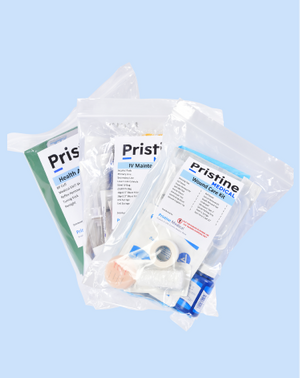
Pristine Medical is the premier provider of simulation PPE supplies. You can find all the essential PPE needed to properly train your students in infection control procedures, including goggles, gowns, gloves, masks, and hand sanitizer
Frequently Asked Questions About PPE Donning and Doffing Training
1. What is PPE donning and doffing?
PPE donning and doffing refers to the proper process of putting on and removing personal protective equipment. Donning means putting PPE on before patient contact, while doffing means removing it afterward in a way that reduces the risk of contaminating the wearer, other people, or the surrounding environment.
2. Why is PPE donning and doffing training important?
3. What PPE should students practice using during infection control training?
4. What is the correct order for putting on PPE?
5. What is the correct order for removing PPE?
6. Why is doffing PPE considered especially important?
7. What is the difference between sterile and non-sterile gloves?
8. How does simulation improve PPE training?
9. What types of precautions should be included in PPE training?
10. Where can I find PPE supplies for medical simulation training?