

IM Injection Sites Compared: Deltoid vs Ventrogluteal vs Vastus Lateralis for Nursing Students
Deltoid, ventrogluteal and vastus lateralis are the three primary intramuscular (IM) injection sites that nursing students must learn to identify and use correctly based on patient age, medication volume and anatomical safety.
Key things to know:
- The main differences between the deltoid, ventrogluteal and vastus lateralis IM injection sites
- Why the deltoid muscle is commonly used for vaccines and small-volume injections
- How to locate the deltoid injection site 2–3 fingerbreadths below the acromion process
- Why the ventrogluteal site is considered the safest location for larger-volume IM injections in adults
- How the ventrogluteal muscle allows injections of thicker or oil-based medications
- Why the vastus lateralis muscle is the preferred IM injection site for infants and young children
- Recommended injection volumes for infants, children and adults in the vastus lateralis
- The importance of selecting the correct needle length based on body mass and muscle depth
One of the first things that nursing students learn in nursing school is how to administer an intramuscular (IM) injection. Nurses frequently administer IM injections to deliver essential medication underneath a patient’s muscle tissue, where it can quickly absorb into the bloodstream.
The standard methodology of IM injections is to insert a syringe at a 90-degree angle deep into the muscle. However, choosing the proper site for the injection is just as important as how you administer the IM injection. That is why every nursing student must learn about the three most common IM injection sites and when it is appropriate to use them.
The Deltoid Muscle
The deltoid muscle is commonly referred to as the shoulder muscle. It is a large triangular-shaped muscle covering and stabilizing the glenohumeral joint within the shoulder. It is responsible for giving the shoulder its round-like appearance.
The deltoid is a popular IM injection site because it is considered the most accessible of the other sites. It is administered in the upper arm area rather than directly into the shoulder because there is more thick muscle tissue in the central part of the deltoid muscle. The shoulder itself is really just a large joint surrounded by major nerves, tendons, and ligaments, so it would be too risky to inject directly into it.
Tell your nursing students to make the injection approximately 2 to 3 fingerbreadths below the acromion process, which is the high bony point of the shoulder that forms the triangular arch. Fingerbreadths are a form of measurement representing the width of the finger. So, 2 fingerbreadths would be equal to the width of two fingers combined.
Best Use Case
Nurses will typically choose the deltoid site for IM injections when administering vaccines to adult patients. In fact, it is suitable for virtually all small-volume injections consisting of less than 1 mL of medicine. In some cases, a healthy adult may receive up to 2 mL in the deltoid site, but it would end up causing them more discomfort.
The deltoid lies near the radial nerve. If too much irritating medication enters, it can cause tingling, numbness, and possibly even long-term nerve damage and motor deficiencies.
The Ventrogluteal Muscle
The ventrogluteal muscle is best known as being the safest IM injection site for adults because it is farthest away from major blood vessels and nerves. It is on the patient’s lateral hip area, where the thick gluteus medius muscle resides. Since there is minimal subcutaneous fat covering the muscle, it is easier to perform deep IM injections without worrying about the medication getting accidentally deposited into the fat.
Students can easily identify the ventrogluteal IM injection site by placing their palm over the greater trochanter of the lateral hip area and forming a V-shape with their index finger and middle finger. The trochanter represents the two bony protuberances that attach the muscles to the upper thigh bone.

The IM injection goes within the V-shape formation of the index and middle fingers,
safely away from the sciatic nerve. It is a well-developed muscle area that can withstand as much as 3 to 4 mL of medicinal solution. However, many newer students feel uncomfortable locating the ventrogluteal IM injection site because they are not as familiar with it, or they’re hesitant to touch the patient’s hip.
Best Use Case
Ventrogluteal IM injections are best used to administer large volumes of medications to patients. Some examples include administering Vitamin B12 when a patient suffers from a vitamin deficiency. Nurses may also administer ventrogluteal IM injections to deliver antibiotics to patients suffering from severe infections.
The administered solutions are usually viscous or oily, both of which are suitable for injection sites with high muscle density. If used in smaller muscle areas, such as the deltoids, these solutions would likely cause tissue damage.
The Vastus Lateralis Muscle
The vastus lateralis is a quadricep muscle located in the outer middle third of the lateral thigh area of the leg. It is one of the largest and most powerful muscles in the body. Nurses choose the vastus lateralis for IM injections when the deltoid and gluteal areas are deemed unsafe for them. The muscle is much easier to access and even safer than the ventrogluteal injection site since there are no major nerves or blood vessels around.
For this reason, nurses will administer vastus lateralis-based IM injections on infants and young children. Since the gluteal muscles are undeveloped in them, the only safe alternative for an IM injection is the vastus lateralis muscle. That is why medical professionals view the vastus lateralis as the pediatric standard for IM injections.
Just make sure your nursing students realize that different volume amounts are recommended for infants, children, and adults. The rule of thumb is to administer no more than 1 mL to an infant, 2 mL to a child, and 3mL to an adult. And even though these injections are safe for them, they may cause post-injection soreness afterward when an adult or child patient gets up and walks around again.
Best Use Case
Vastus lateralis IM injections are best used for administering pediatric immunizations and emergency medications. Nursing students must learn to view the thigh area in thirds from both a vertical and horizontal angle. The objective is to administer the injection in the outer middle third area.
The Importance of Needle Selection
Selecting the appropriate IM injection site is the only important part of the procedure. The other important part is selecting the appropriate needle length to accommodate the patient’s body size and mass.
For instance, a short needle cannot effectively penetrate the muscle of an obese patient because the medication could be deposited into their fatty tissue, resulting in less absorption in the body. Then, of course, choosing a needle too long can risk injuring the patient’s bone and nerves.
Nursing students must assess a patient’s body mass index, age, muscle mass, and mobility to determine the best needles to use.
Get Your IM Injection Supplies Today
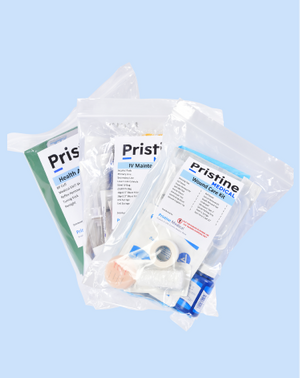
Pristine Medical is the premier provider of IM injection supplies for nursing and medical schools. We have quality supplies to help your nursing students practice in a simulated situation, such as a Simulation Injection Pad and Standardized IM kit.
Frequently Asked Questions About Intramuscular Injection Sites for Nursing Students
1. What are the main differences between the deltoid, ventrogluteal and vastus lateralis IM injection sites?
The deltoid is located in the upper arm and is commonly used for small-volume injections such as vaccines. The ventrogluteal site is on the lateral hip and is considered one of the safest sites for larger medication volumes. The vastus lateralis is located on the outer thigh and is often used when other sites are unsuitable, especially in infants and young children.
2. When should nursing students use the deltoid muscle for an intramuscular injection?
3. Why is the ventrogluteal muscle considered one of the safest IM injection sites?
4. Why is the vastus lateralis muscle commonly used for pediatric IM injections?
The vastus lateralis muscle in the outer thigh is well developed even in infants and young children. Because there are no major nerves or blood vessels nearby, it provides a safe and accessible site for administering pediatric immunizations and emergency medications.
5. How does needle selection affect the success of an intramuscular injection?
The needle length must match the patient’s body size and muscle mass so the medication reaches the muscle tissue properly. A needle that is too short may deposit medication into fatty tissue, while a needle that is too long may risk contacting bone or nerves.
6. Why is choosing the correct IM injection site important for nursing practice?
Selecting the correct injection site helps ensure medication is absorbed properly and reduces the risk of nerve injury, tissue damage or unnecessary discomfort for the patient. Proper site selection is a fundamental skill nursing students must develop during their training.