

Top Skills Most Commonly Tested in OSCEs (And What Every Station Should Include)
This article explains the key skills assessed during Objective Structured Clinical Examinations (OSCEs) and outlines what every OSCE station should include to support fair, realistic student evaluation. It covers communication, physical assessment, procedural skills, and clinical reasoning, along with practical guidance for setting up effective OSCE stations.
What you’ll learn:
-
How OSCE stations are structured and why timing matters
-
The four core skills most commonly assessed during OSCEs
-
Why communication and empathy are critical evaluation criteria
-
How procedural skills and sterility are tested
-
What every OSCE station must include for accurate assessment
-
How tools, simulated patients, and manikins support OSCE success
The Objective Structured Clinical Examination (OSCE) is a standardized healthcare test in which students rotate through multiple timed stations to perform specific tasks, such as physical examinations, medication administration, and wound care. Each station is essentially a simulation of a particular task, designed with the tools, manikins, and aesthetics needed to make the environment look realistic.
The Top Skills Tested
The instructors assess each student’s progress at the stations to ensure they did everything correctly. They focus primarily on how well the student demonstrates various vital skills needed to be a true medical professional. These skills will determine whether a student can ever succeed as a medical doctor or a nurse.
Let’s explore the top four skills most commonly tested in OSCEs:
1) Communication Skills
One of the most critical skills tested is communication. Students must have exemplary communication skills to succeed in the healthcare industry. Instructors will assess how well the students communicate with the simulated patients at the stations. They want to see if the students know how to ask the right questions while making the patients feel comfortable.
Did the student show empathy and not sound like a robot? Did they ask the right questions? These questions will be assessed.
2) Physical Assessments
OSCE stations are designed to teach students how to conduct various physical assessments of a patient’s abdominal, respiratory, neurological, and cardiovascular systems. The instructors want to see whether the students know how to check a person’s core areas, such as the stomach, lungs, and heart.
Students must demonstrate proficiency and skill in using various high-quality diagnostic tools, including a stethoscope, reflex hammer, shears, tuning fork, blood pressure cuff, and penlight. They will be asked to test a patient for various medical conditions, such as high blood pressure, breathing sounds, and rapid heart rate.
All these items are typically found in a standardized health assessment kit. If you include one of these kits at each station where physical assessments are conducted, you can observe how well your students use them.
3) Procedural Skills
Demonstrating procedural skills is the main part of the examinations. Instructors want to see students perform hands-on medical procedures and interventions to treat patients appropriately.
For instance, one station may be set up for IV insertions and venipuncture. A student at this station would have to demonstrate that they can locate the appropriate vein and correctly insert a properly sized needle into it. Since a single mistake could injure the patient, students must demonstrate their procedural skills flawlessly to pass the examination.
Other procedural skills tested may include suturing (wound care), local anesthesia, and surgical scrubbing. Students must also demonstrate their commitment to maintaining a clean and sterile clinical environment when working with patients at the stations. Failure to establish safety will result in points against the student, even if the procedure was correctly performed.
4) Clinical Reasoning
Students need clinical reasoning skills to succeed as medical professionals. Clinical reasoning gives students a chance to apply their newfound medical knowledge to interpret data, plan treatments, and make critical decisions to help their patients as best as possible.
No student should ever guess what to do. Medicine is a science driven by tests and data. Students must rely on medical testing and data to make the best decisions for their patients. It is the only way they can rule out other conditions while pinpointing the patient’s exact condition.
What Every Station Should Include
Each OSCE station is like a performance stage. As students rotate to the various stations, they will perform a specific task for their instructors. The only way they can do that is if the “stage” includes the appropriate supporting elements. What could they be?
Here are the top three features that every OSCE station should include:
1) Clear Instructions
The number one feature to include at every OSCE station is clear instructions posted on the wall for the students. Since these are timed sessions, you’ll want students to know exactly what they are expected to do at the station the moment they arrive there. The instructions will also include vital patient information, such as their age, name, and current complaint.
In a real-world setting, a professional would take more time to understand the patient’s background and medical history. But since students are short on time, they are provided with patient information to help them complete the task more quickly.
2) The Patient
Every station must have a patient of some kind for students to work with. It could be a simulated human patient or a high-fidelity manikin. Many schools prefer to use simulated human patients because they help test each student’s communication skills. Unfortunately, even the most sophisticated high-fidelity manikins cannot talk back to the students.
Simulated patients are actors trained to portray real patients. They know how to respond to every action and will provide students with feedback along the way. If the students need to perform actual physical procedures, a station may use a combination of simulated patients and task trainers or manikins. The simulated patient will act out the reaction to what the students do to the trainers and manikins.
3) The Tools
Lastly, every OSCE station must be equipped with all essential medical tools and supplies for the assessment. Ensure all the stations are fully stocked with either standardized kits or individual medical items (or both).
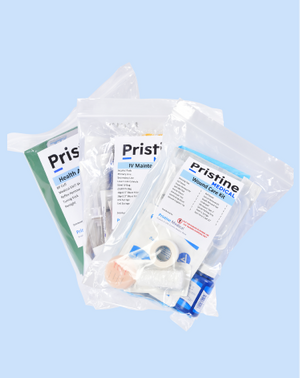
For instance, a wound care station could have a standardized wound care kit with a dressing tray, underpad, surgical tape, suture removal kit, exam gloves, gauze sponges, and bandages. If it is an IV insertion station, a standardized IV insertion kit would be the most appropriate item to include in its inventory.
Get Medical Supplies for Your Stations
Do you need realistic simulation medical supplies and tools for your OSCE stations? Pristine Medical is the top provider of simulation medical items for schools conducting OSCEs.
Frequently asked questions about OSCE skills and exam stations
1. What is an OSCE exam?
An OSCE (Objective Structured Clinical Examination) is a standardized exam where students rotate through timed stations to perform specific clinical tasks in a simulated healthcare environment.
2. What skills are most commonly tested during OSCEs?
3. Why are communication skills important in OSCE exams?
4. What procedural skills are evaluated at OSCE stations?
Procedural skills may include IV insertion, venipuncture, wound care, suturing, administering local anesthesia, and maintaining a sterile environment during procedures.
5. What should every OSCE station include?
Every OSCE station should include clear written instructions, a simulated patient or manikin, and all required medical tools or standardized kits needed to complete the task.
6. Why are standardized tools and kits important for OSCEs?
Standardized tools and kits ensure fairness by giving every student access to the same equipment, allowing instructors to evaluate performance accurately and consistently.