

Selecting the Right Needle Gauge for Simulation: Educator’s Practical Guide
This article explains how to choose the correct needle gauge for medical simulation training and why gauge selection matters for realism, safety, and skill development. It covers common needle gauges used in simulation labs and provides guidance for intramuscular, subcutaneous, IV insertion, and blood draw training scenarios.
What you’ll learn:
-
What needle gauge means and how gauge sizes differ
-
Why selecting the correct needle gauge matters in simulation training
-
Recommended needle gauges for intramuscular and subcutaneous injections
-
How to choose needle gauges for IV insertion and emergency scenarios
-
Best needle gauges for blood draw and venipuncture training
-
How manikins, injection pads, and simulation arms support safe practice
When you’re managing a simulation lab at a medical school, you have a responsibility to give your students a realistic educational experience. It is the only way they will be prepared to work in an actual clinical setting. Choosing the right needle gauge for your medical simulations is imperative for the success of your lessons.
What is a Needle Gauge?
A needle gauge is the measurement of a needle’s diameter. It is how you determine whether a needle is too thick or too thin for what you want to use it for. A lower gauge number means the needle is thicker with a bigger hole, while a higher gauge number means the needle is thinner with a smaller hole.
For instance, a 16-gauge needle is a thick needle with a 40mm long base and a 1.6mm hole, while a 30-gauge needle is a thin needle with an 8mm long base and a 0.30mm hole. There are several other needle gauges between them, such as 18g, 20g, 25g, and so on. The needle gauge sizes are printed directly on the needle packaging, although some needles have them on the plastic hub that connects to the syringe.
Your simulation lab should stock every needle gauge size, starting from the thickest 16g to the thinnest 30g. That way, your students can learn how to study the measurements on the packaging to help find the needle gauge most appropriate for their simulation training scenario.
As an educator, you should also become proficient in knowing which needle gauge is appropriate for each particular simulated lesson, such as intramuscular injections, subcutaneous injections, IV access, and drawing blood. More about these gauge differences will be discussed further in the article.
Why Do You Need to Pick the Right Needle Gauge?
Picking the wrong needle gauge could have devastating consequences on the patient, such as increased bruising, pain, and potential tissue damage. These are the symptoms you often see when the needle gauge is too thick. However, a needle gauge that is too thin can also cause problems for a patient, such as slower administration of medication, clogging, and increased anxiety. If they need the medication quickly, they will suffer the ramifications of not getting their medication.
Now, in terms of a simulation setting, you’ll still want to create a realistic clinical environment where students see the consequences of picking the wrong needle gauge. A sophisticated simulation that uses virtual reality and manikins can create this realistic experience for them. If the student chooses the incorrect needle, let them see the bleeding, bruising, or whatever other consequences. It is the only way they will learn from their mistakes and choose a better needle next time.
That is why it is imperative to include high-fidelity manikins in your simulation laboratory. Students can practice on the manikins as if they were real people without worrying about hurting them. Meanwhile, the manikins will still react and exhibit visible symptoms if a mistake is made, especially if they are high-fidelity. Some high-fidelity manikins can even bleed artificial blood.
On the other hand, if you’re on a limited budget and cannot afford to stock your simulation labs with high-fidelity manikins, you can stock them with simple simulation injection pads instead. Injection pads are high-fidelity training tools that mimic multiple layers of human skin. Students can easily practice various injection techniques on the same pad, as it withstands hundreds of needle punctures.
How to Choose the Right Needle Gauge for Intramuscular Injections
Intramuscular injections are administered directly into the patient’s muscle, usually in the thigh, hip, or shoulder. Since muscle tissue is deeper and has more blood flow than skin tissue, you need to use a longer and thicker needle to make it through the fatty layer. Just be sure the needle is not too thick, or it could cause the patient pain.
The best advice is to choose a needle gauge somewhere between 22g and 25g. Anything lower than 22g would be too thick for penetrating deep muscle tissue, whereas anything higher than 25g would be too thin to break through that deep. Of course, you must also take into account the patient’s body mass, age, and muscle mass, but the 22-25g range is the standard.
When students use the 22g needle to pierce a manikin’s synthetic skin, they will hear a natural popping sound. Make sure your students use safety needles with a built-in cover to teach students to protect themselves from accidental injuries after removing the needles.
How to Choose the Right Needle Gauge for Subcutaneous Injections
Subcutaneous injections are administered into the fatty tissue beneath the patient’s skin. These injections are best for dispensing small volumes of medicine, such as blood thinners or insulin. A long needle is not necessary to administer a subcutaneous injection because the target area is close to the skin surface.
Therefore, the best needle gauge for subcutaneous injections will be thinner and shorter, between 25g and 27g. They are okay to practice on simulation manikins and training pads as long as the skin material is delicate enough. If not, these thinner needles are more likely to break due to the amount they bend.
How to Choose the Right Needle Gauge for IV Insertion
Intravenous (IV) insertions are when medical professionals insert a needle with a catheter into the patient’s vein to deliver fluids, medication, or nutrients. It may also be done for blood drawing or transfusion.
Choosing needle gauges for IV insertions is trickier. The proper size depends on factors such as the patient’s age, vein size, purpose, and location. A student would not use the same needle gauge for every type of IV insertion, so make sure they understand that.
Most professional IV catheters are color-coded to indicate emergency use. They are meant to help emergency workers, doctors, and nurses quickly identify the correct needle gauges without consulting the packaging.
Here are some of the standard colors and corresponding gauges:
-
18-Gauge (Green) – Best for quick blood transfusions and blood administration in trauma situations.
-
20-Gauge (Pink) – Best for standard administration of medications and fluids to an adult.
-
22-Gauge (Blue) – Best for use on people with smaller, fragile veins, such as elderly people
-
24-Gauge (Yellow) – Best for use in pediatric cases involving infants and children.
Some countries and jurisdictions use different color codes to identify various needle gauges. You must understand your country's color codes so you can relay the information to your students. You could post a chart on the wall of your simulation lab to help your students identify the correct needle gauges for emergency and standard IV insertions.
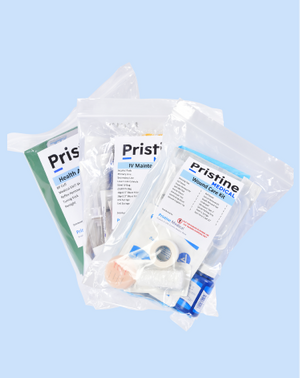
Don’t forget to grab a standardized IV insertion kit for your simulation lab. The kit includes all standard IV insertion accessories, including 22 G and 20 G needles.
How to Choose the Right Needle Gauge for Drawing Blood
Drawing blood (phlebotomy) or administering medication to a patient is one of the most common tasks that nurses and doctors perform on the job. The best needle gauge range for drawing blood is 21-23g. Many medical practitioners will recommend the 23-gauge, commonly referred to as a butterfly needle.
The smaller “butterfly” needle is ideal for drawing blood from a patient’s arm because it causes minimal injury or bleeding. Most simulation arms have realistic skin that can tolerate a puncture from a narrower needle point like this one. It is best to use a venipuncture arm as the simulation arm in this training scenario.
The venipuncture arm features lifelike skin that can withstand a 22-gauge needle puncture. Its simulated veins are accessible by entering the forearm or the back of the hand. The best part is that the skin and veins are replaceable to preserve the arm’s life.
Use Your Best Clinical Judgment
As the educator, your job is to observe your students and ensure they choose the appropriate needle gauges for their training. If you can understand how different needle gauges are relevant based on a patient’s age, condition, and procedure type, then you won’t have a problem identifying the right needle gauge in the future.
Again, keep in mind that simulation arms, pads, and manikins may have skin that is slightly thicker or thinner than human skin (even though they are supposed to replicate human skin). For this reason, you should take the time to practice using different needle gauges on your simulation arms, pads, and manikins to test out their effectiveness. Some injection types may require a needle gauge slightly higher or lower than the standard.
Stock Up on Your Needle Supply Today!
Pristine Medical is the premier provider of simulation needles for medical and nursing schools. Many needles are sold by gauge, but you can find needle gauge assortment packages with gauges of different sizes. They might be more convenient to purchase if you want to test out certain needle gauges before buying them in bulk.
Frequently asked questions about needle gauge selection in simulation training
1. What does needle gauge mean?
Needle gauge refers to the diameter of the needle. Lower gauge numbers indicate thicker needles, while higher gauge numbers indicate thinner needles with smaller openings.
2. Why is choosing the correct needle gauge important in simulation labs?
3. What needle gauge is recommended for intramuscular injection training?
4. Which needle gauges are best for subcutaneous injections?
Subcutaneous injection training usually uses thinner, shorter needles in the 25g to 27g range, as the medication is delivered into fatty tissue just beneath the skin.
5. How do students choose the correct needle gauge for IV insertion?
IV needle gauge selection depends on factors such as vein size, patient age, and purpose of the IV. Common gauges include 18g for trauma, 20g for standard adult use, 22g for fragile veins, and 24g for pediatric cases.
6. What needle gauge is best for blood draw and venipuncture training?
Blood draw training commonly uses needle gauges between 21g and 23g, with 23g butterfly needles preferred for minimizing tissue damage and improving patient comfort.